---
title: "Build Habitat"
---
```{r, include = FALSE}
library(tidyverse)
library(lubridate)
library(ggpubr)
library(egg)
```
***if any changes are made, need to re-run `qmd_to_r_script()` at end, in console***
**Purpose:** Define `build_habitat()`, a function that simulates habitat conditions (temperature and food availability) for a simple, spatially-implicit habitat network consisting of two patches. Returns a `habitat_df` time series covering the full burn-in and experiment periods.
*Notes:*
* In theory, the habitat network is generalizable and can be expanded to include as many patches as needed. But in doing so we will need to update the simulation to allow more than 2 patches.
* We can specify food available in one of two ways: ration size in g/g/d or proportion of maximum consumption (P_C~max~). Fullerton's IBM in Armstrong et al. (2021) sets a constant ration size (g/g/d) in each patch, and varies this from upstream to downstream. The problem with this is that it forces small fish to feed way below C~max~, but as fish grow and allometric C~max~ declines, fish feed much closer to or at C~max~. Therefore, growth rates are low and constraining for small fish, but increase as fish grow larger, such that fish are less constrained by food availability.
+ Many researchers using bioenergetics models simply set a constant P_C~max~, then estimate growth from that. But the problem with this, as Railsback points out, is that under warmer conditions fish are able to attain higher ration sizes simply because of the temperature dependence function: C = Cmax * p * f(T). Thus, there is no way to separate ration size from habitat temperature using a constant P_C~max~.
+ Instead, we can simply modify the temperature dependence function to set some threshold P_C~max~. Basically, temperature acts on ration/consumption up to some threshold value of P_C~max~, above which body size alone limits consumption (via allometric C~max~).
## `build_habitat()`
Build a `habitat_df` time series from a named parameter list. Patch parameters (`pcmax`, `A`, `K`, `S_max`) are held at their burn-in values and then optionally ramped to target values at the start of the experiment period. Setting `ramp_years = 0` gives an immediate step change; any positive value linearly interpolates to the target over that many years.
**Parameter list keys** (all have defaults matching the current scenario):
*Timeline:* `nyears_burnin`, `nyears_experiment`, `mindate`
*Temperature (per patch):* `base_temp_warm/cold`, `amplitude_warm/cold`, `peak_doy_warm/cold`, `temp_min_warm/cold`, `temp_noise_warm/cold`
*Patch burn-in values:* `pcmax_warm/cold`, `A_warm/cold`, `K_warm/cold`, `S_max_warm/cold`
*Experiment targets* (NA = no change): `pcmax_warm/cold_target`, `A_warm/cold_target`, `K_warm/cold_target`, `S_max_warm/cold_target`, `ramp_years`
*Seed:* `seed`
```{r}
build_habitat <- function(params = list()) {

  # ── Timeline ────────────────────────────────────────────────────────────────
  nyears_burnin     <- params$nyears_burnin     %||% 20
  nyears_experiment <- params$nyears_experiment %||% 20
  mindate           <- params$mindate           %||% as.Date("2001-05-01")

  maxdate <- mindate + years(nyears_burnin) + years(nyears_experiment)
  dates   <- seq(mindate, maxdate, by = "day")
  n       <- length(dates)
  doy     <- as.numeric(format(dates, "%j"))

  # ── Temperature ─────────────────────────────────────────────────────────────
  # Each patch is an independent annual sine wave with optional daily noise.
  # Defaults for the cold patch preserve the original cold_multiplier = 0.6 behaviour
  # (base_temp_cold = 11 * 0.6 = 6.6; amplitude_cold = 14 * 0.6 = 8.4).

  # Warm patch
  base_temp_warm  <- params$base_temp_warm  %||% 11     # mean annual temperature (°C)
  amplitude_warm  <- params$amplitude_warm  %||% 14     # seasonal amplitude (°C)
  peak_doy_warm   <- params$peak_doy_warm   %||% 213    # day of peak temperature (Aug 1)
  temp_min_warm   <- params$temp_min_warm   %||% 0.5    # minimum temperature floor (°C)
  temp_noise_warm <- params$temp_noise_warm %||% 0      # daily noise SD (0 = deterministic)

  # Cold patch
  base_temp_cold  <- params$base_temp_cold  %||% 6.6
  amplitude_cold  <- params$amplitude_cold  %||% 8.4
  peak_doy_cold   <- params$peak_doy_cold   %||% 213
  temp_min_cold   <- params$temp_min_cold   %||% 0.3
  temp_noise_cold <- params$temp_noise_cold %||% 0

  # Simulate one patch: sine wave + noise, floored at temp_min, capped at 25 °C
  sim_temp <- function(doy, base_temp, amplitude, peak_doy, temp_min, noise_sd, n) {
    phase <- peak_doy - 365 / 4   # shift so sin() peaks on peak_doy
    temps <- base_temp + amplitude * sin(2 * pi * (doy - phase) / 365)
    noise <- rnorm(n, 0, noise_sd)
    pmax(temp_min, pmin(25, temps + noise))
  }

  set.seed(params$hab_seed %||% 123)
  simulated_temp      <- sim_temp(doy, base_temp_warm, amplitude_warm,
                                  peak_doy_warm, temp_min_warm, temp_noise_warm, n)
  simulated_temp_cold <- sim_temp(doy, base_temp_cold, amplitude_cold,
                                  peak_doy_cold, temp_min_cold, temp_noise_cold, n)

  habitat_df <- tibble(
    date     = dates,
    doy      = doy,
    dayofsim = seq_along(dates),
    temp_warm = round(simulated_temp,      digits = 1),
    temp_cold = round(simulated_temp_cold, digits = 1)
  )

  # ── Patch parameters (burn-in values) ───────────────────────────────────────
  # Use [[ for exact matching — $ partial-matches e.g. params$A_cold to A_cold_target.
  # Stored as time series columns so they can vary during the experiment period.
  habitat_df <- habitat_df |>
    mutate(
      pcmax_warm = params[["pcmax_warm"]]  %||% 0.5,    # max proportion of C_max
      pcmax_cold = params[["pcmax_cold"]]  %||% 0.5,
      A_warm     = params[["A_warm"]]      %||% 1.0,    # patch area (arbitrary units)
      A_cold     = params[["A_cold"]]      %||% 1.0,
      K_warm     = params[["K_warm"]]      %||% 500,    # half-saturation density (fish/area)
      K_cold     = params[["K_cold"]]      %||% 500,
      S_max_warm = params[["S_max_warm"]]  %||% 0.9994, # max daily survival probability
      S_max_cold = params[["S_max_cold"]]  %||% 0.9994
    )

  # ── Experiment period ramps ──────────────────────────────────────────────────
  # After the burn-in period, one or more patch parameters can be ramped to new
  # target values. Set a target to NA to leave that parameter unchanged.
  exp_start_date <- mindate + years(nyears_burnin)
  d_exp_start    <- which(habitat_df$date == exp_start_date)
  ramp_years     <- params$ramp_years %||% nyears_experiment

  # Linear ramp from end-of-burn-in value to target_val over ramp_yrs years,
  # then holds target_val for the remainder. ramp_yrs = 0 gives a step change.
  apply_ramp <- function(col, d_start, target_val, ramp_yrs) {
    baseline  <- col[d_start - 1]
    n_ramp    <- max(round(ramp_yrs * 365.25), 1)
    exp_idx   <- d_start:length(col)
    ramp_frac <- pmin(seq_along(exp_idx) / n_ramp, 1)
    col[exp_idx] <- baseline + (target_val - baseline) * ramp_frac
    col
  }

  params_to_change <- list(
    pcmax_warm = params$pcmax_warm_target %||% NA_real_,
    pcmax_cold = params$pcmax_cold_target %||% NA_real_,
    A_warm     = params$A_warm_target     %||% NA_real_,
    A_cold     = params$A_cold_target     %||% NA_real_,
    K_warm     = params$K_warm_target     %||% NA_real_,
    K_cold     = params$K_cold_target     %||% NA_real_,
    S_max_warm = params$S_max_warm_target %||% NA_real_,
    S_max_cold = params$S_max_cold_target %||% NA_real_
  )

  for (param in names(params_to_change)) {
    target <- params_to_change[[param]]
    if (!is.na(target)) {
      habitat_df[[param]] <- apply_ramp(habitat_df[[param]], d_exp_start, target, ramp_years)
    }
  }

  habitat_df
}
```
## `plot_habitat()`
Plot the temperature regimes and patch parameter time series from a `habitat_df`.
**Arguments:**
* `habitat_df` — output of `build_habitat()`
* `exp_start_date` — a `Date` marking the burn-in/experiment boundary (draws a vertical dashed line). Pass `NULL` to omit.
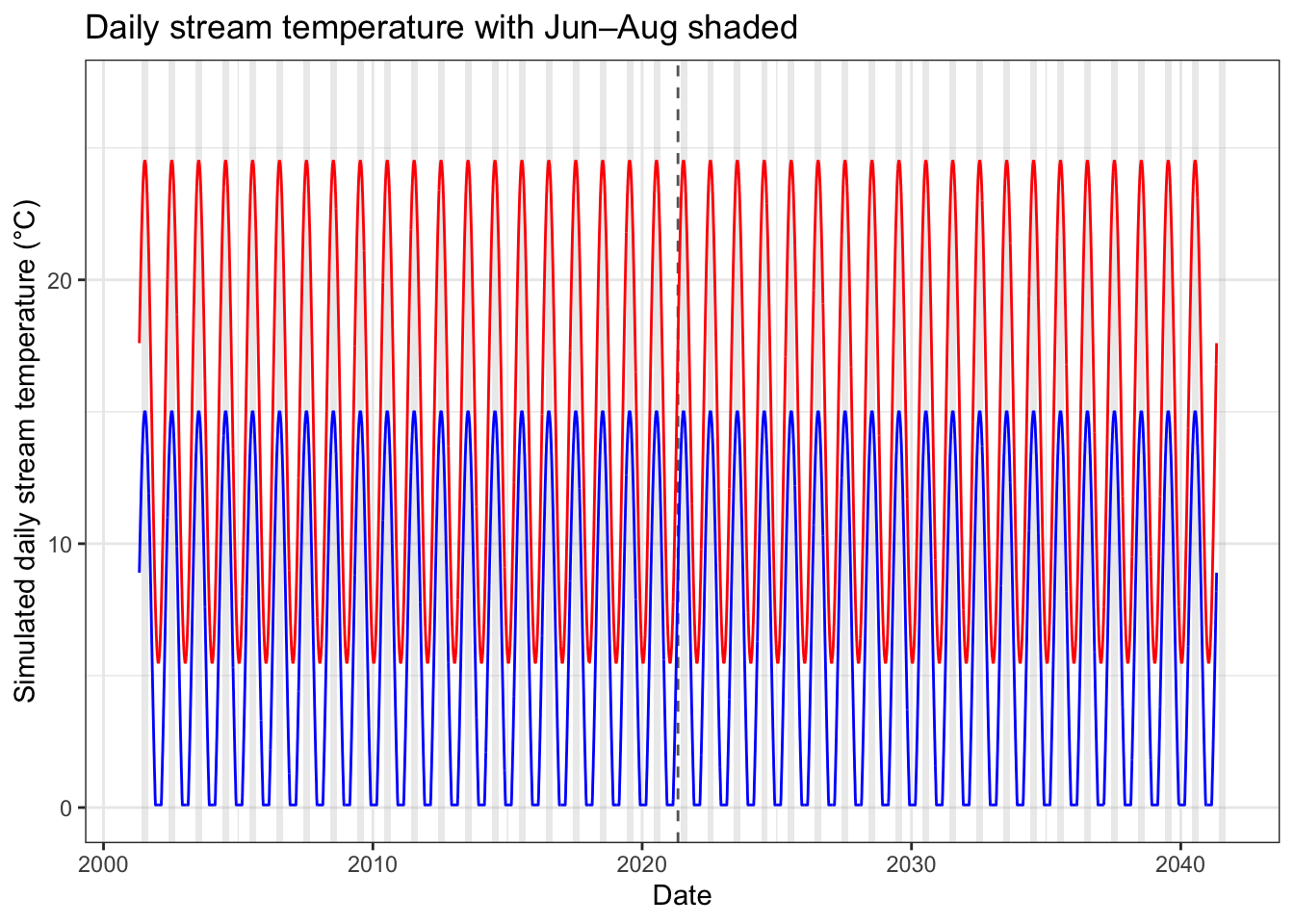
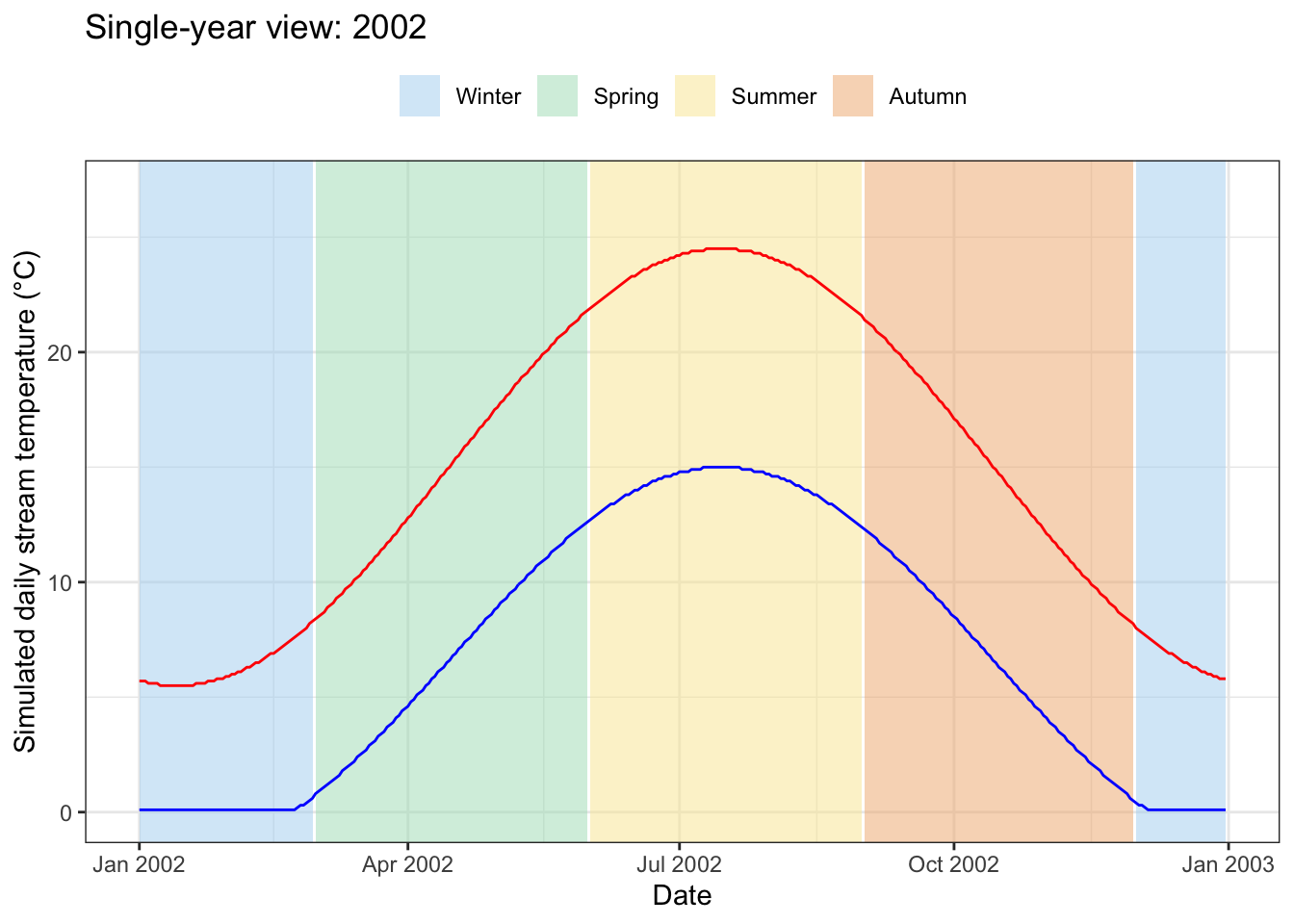
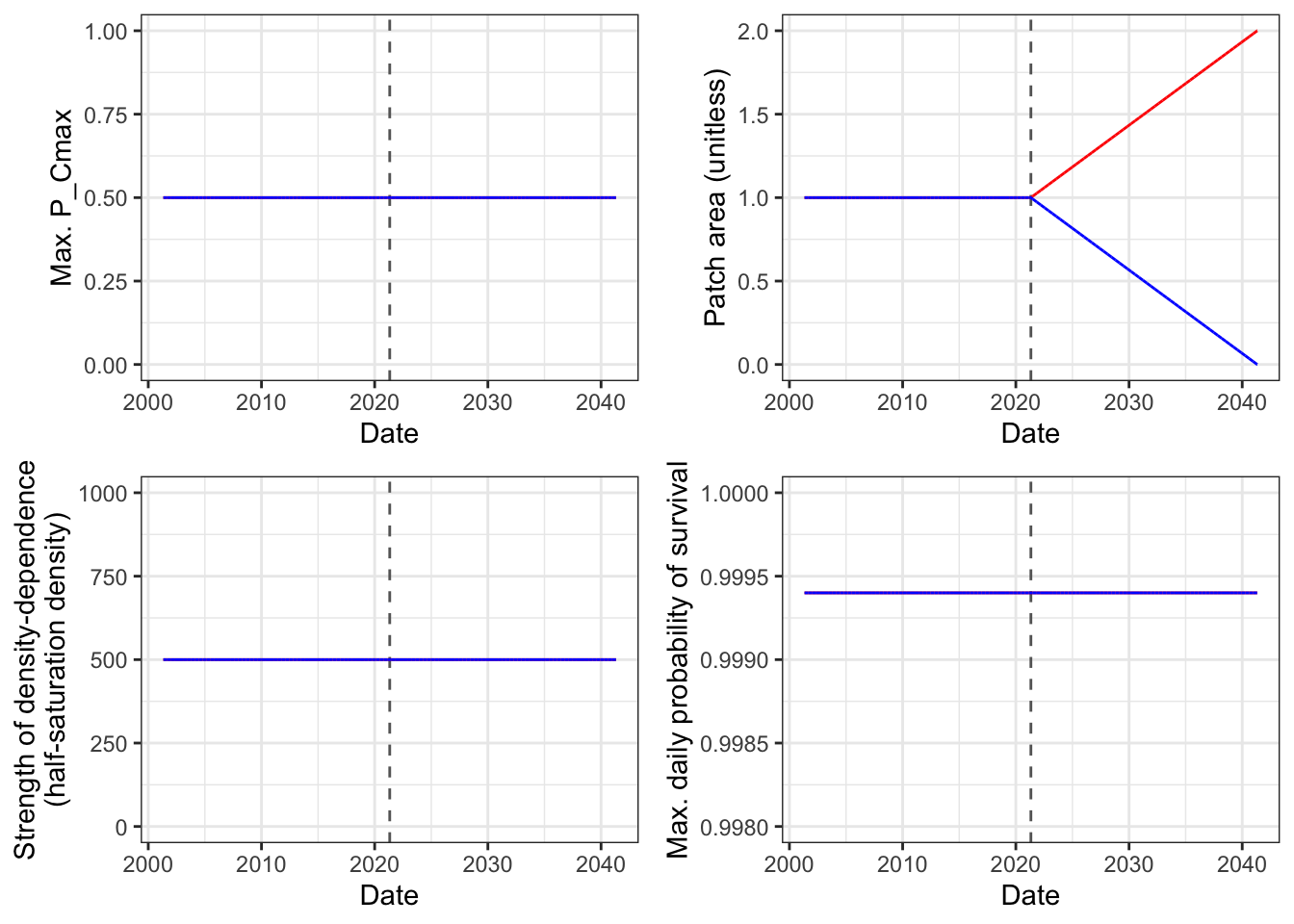
Produces three figures: full temperature time series, a single-year temperature view, and a 2×2 panel of patch parameter time series. Returns the individual plot objects invisibly as a named list.
```{r}
plot_habitat <- function(habitat_df, exp_start_date = NULL) {

  # Second calendar year in the data — used for the single-year temperature view
  ref_year <- year(min(habitat_df$date)) + 1

  # Jun–Aug shading rectangles
  summer_shading <- data.frame(
    xmin = as.Date(paste0(unique(format(habitat_df$date, "%Y")), "-06-01")),
    xmax = as.Date(paste0(unique(format(habitat_df$date, "%Y")), "-08-31")),
    ymin = -Inf, ymax = Inf
  )

  # Helper: optionally add experiment-start vline
  vline <- if (!is.null(exp_start_date)) {
    geom_vline(xintercept = exp_start_date, linetype = "dashed", color = "grey40")
  } else {
    NULL
  }

  # ── Temperature: full time series ───────────────────────────────────────────
  p_temp_full <- habitat_df |> ggplot() +
    geom_rect(data = summer_shading,
              aes(xmin = xmin, xmax = xmax, ymin = ymin, ymax = ymax),
              fill = "grey", alpha = 0.3, inherit.aes = FALSE) +
    vline +
    geom_line(aes(x = date, y = temp_warm), color = "red") +
    geom_line(aes(x = date, y = temp_cold), color = "blue") +
    theme_bw() +
    xlab("Date") +
    ylab("Simulated daily stream temperature (°C)") +
    labs(title = "Daily stream temperature with Jun–Aug shaded") +
    ylim(0,27)

  # ── Temperature: single-year view ───────────────────────────────────────────
  season_shading <- data.frame(
    xmin   = as.Date(c(paste0(ref_year, "-01-01"),
                       paste0(ref_year, "-03-01"),
                       paste0(ref_year, "-06-01"),
                       paste0(ref_year, "-09-01"),
                       paste0(ref_year, "-12-01"))),
    xmax   = c(as.Date(paste0(ref_year,     "-03-01")) - 1,  # last day of Feb (leap-year safe)
               as.Date(paste0(ref_year,     "-06-01")) - 1,
               as.Date(paste0(ref_year,     "-09-01")) - 1,
               as.Date(paste0(ref_year,     "-12-01")) - 1,
               as.Date(paste0(ref_year + 1, "-01-01")) - 1),
    season = factor(c("Winter", "Spring", "Summer", "Autumn", "Winter"),
                    levels = c("Winter", "Spring", "Summer", "Autumn"))
  )

  p_temp_year <- habitat_df |>
    filter(year(date) == ref_year) |>
    ggplot() +
    geom_rect(data = season_shading,
              aes(xmin = xmin, xmax = xmax, fill = season),
              ymin = -Inf, ymax = Inf, alpha = 0.5, inherit.aes = FALSE) +
    scale_fill_manual(
      values = c(Winter = "#AED6F1", Spring = "#A9DFBF",
                 Summer = "#F9E79F", Autumn = "#F0B27A"),
      name   = NULL
    ) +
    geom_line(aes(x = date, y = temp_warm), color = "red") +
    geom_line(aes(x = date, y = temp_cold), color = "blue") +
    theme_bw() +
    theme(legend.position = "top") +
    xlab("Date") +
    ylab("Simulated daily stream temperature (°C)") +
    labs(title = paste("Single-year view:", ref_year)) +
    ylim(0,27)

  # ── Patch parameters: 2×2 panel ─────────────────────────────────────────────
  p_pcmax <- habitat_df |> ggplot() +
    vline +
    geom_line(aes(x = date, y = pcmax_warm), color = "red") +
    geom_line(aes(x = date, y = pcmax_cold), color = "blue") +
    theme_bw() +
    xlab("Date") + ylab("Max. P_Cmax") +
    ylim(0,1)

  p_area <- habitat_df |> ggplot() +
    vline +
    geom_line(aes(x = date, y = A_warm), color = "red") +
    geom_line(aes(x = date, y = A_cold), color = "blue") +
    theme_bw() +
    xlab("Date") + ylab("Patch area (unitless)") +
    ylim(0,2)

  p_K <- habitat_df |> ggplot() +
    vline +
    geom_line(aes(x = date, y = K_warm), color = "red") +
    geom_line(aes(x = date, y = K_cold), color = "blue") +
    theme_bw() +
    xlab("Date") + ylab("Strength of density-dependence\n(half-saturation density)") +
    ylim(0,1000)

  p_smax <- habitat_df |> ggplot() +
    vline +
    geom_line(aes(x = date, y = S_max_warm), color = "red") +
    geom_line(aes(x = date, y = S_max_cold), color = "blue") +
    theme_bw() +
    xlab("Date") + ylab("Max. daily probability of survival") +
    ylim(0.998,1)

  print(p_temp_full)
  print(p_temp_year)
  egg::ggarrange(p_pcmax, p_area, p_K, p_smax, nrow = 2, ncol = 2)

  invisible(list(
    temp_full = p_temp_full,
    temp_year = p_temp_year,
    pcmax     = p_pcmax,
    area      = p_area,
    K         = p_K,
    S_max     = p_smax
  ))
}
```
## Default habitat
*Current configuration:*
* Temp: warm patch — base 11°C, amplitude 14°C, peak Aug 1. Cold patch — base 6.6°C, amplitude 8.4°C, same peak timing. No noise.
* P_Cmax: constant proportion of maximum consumption, same in each patch. No noise.
* Experiment: cold patch area ramps to 0 and warm patch area ramps to 2 over the full experiment period, simulating loss of cold habitat.
```{r}
hab_params <- list(
  # Timeline
  nyears_burnin     = 20,
  nyears_experiment = 20,
  mindate           = as.Date("2001-05-01"),

  # Temperature — warm patch
  base_temp_warm  = 15,
  amplitude_warm  = 9.5,
  peak_doy_warm   = 196,   # July 15
  temp_min_warm   = 0.5,
  temp_noise_warm = 0,

  # Temperature — cold patch
  base_temp_cold  = 6.6,
  amplitude_cold  = 8.4,
  peak_doy_cold   = 196,
  temp_min_cold   = 0.1,
  temp_noise_cold = 0,

  # Patch burn-in values
  pcmax_warm = 0.5,
  pcmax_cold = 0.5,
  A_warm     = 1.0,
  A_cold     = 1.0,
  K_warm     = 500,
  K_cold     = 500,
  S_max_warm = 0.9994,
  S_max_cold = 0.9994,

  # Experiment targets (NA = no change)
  pcmax_warm_target = NA,
  pcmax_cold_target = NA,
  A_warm_target     = 2,
  A_cold_target     = 0,
  K_warm_target     = NA,
  K_cold_target     = NA,
  S_max_warm_target = NA,
  S_max_cold_target = NA,
  ramp_years        = 20,

  hab_seed = 123
)

habitat_df     <- build_habitat(hab_params)
exp_start_date <- hab_params$mindate + years(hab_params$nyears_burnin)
```
## Temperature and Patch Parameters
```{r}
plot_habitat(habitat_df, exp_start_date)
```
## View data
```{r}
str(habitat_df)
head(habitat_df)
```
## Write R file
For sourcing later.
```{r}
#| eval: false
#| purl: false
file.remove("Habitat.R")
quarto::qmd_to_r_script("Habitat.qmd")
```